
How Fernwood Systems built a multi-tenant CV-screening platform that parses, scores and ranks candidates in minutes, with explainable results and a human making every hiring decision.
The short version
Recruiters at growing African companies can receive hundreds of CVs for a single role. Reading them all is slow, inconsistent and prone to unconscious bias. Screenify, live at screenifyhr.com, is a multi-tenant SaaS platform that takes uploaded CVs, extracts their content with Amazon Textract, parses them with Claude Haiku 5.5 and matches them to the job with Claude Sonnet 5.5, both on Amazon Bedrock, then returns a ranked, explainable shortlist. The recommendation is the platform’s. The decision stays with a person.
The problem: hours of reading, inconsistent results
Manual CV screening has three costs:
- Time: hours per role, repeated for every vacancy.
- Inconsistency: two recruiters, or the same recruiter on two different afternoons, rank the same CV differently.
- Bias: names, schools and origin signals quietly influence who gets shortlisted.
Enterprise applicant-tracking systems solve parts of this, but they are priced and designed for large global buyers. Our customer’s market is African SMBs and growing HR teams, which need something affordable, accountable and fast.
What we built
A recruiter’s workflow is deliberately simple:
- Define the role and its requirements.
- Upload CVs, individually or in bulk.
- Wait minutes, not hours. Screenify processes each CV in the background.
- Review a ranked shortlist with the reasoning behind each score, plus analytics on the talent pool.
- Decide. The platform recommends and people choose.
Architecture
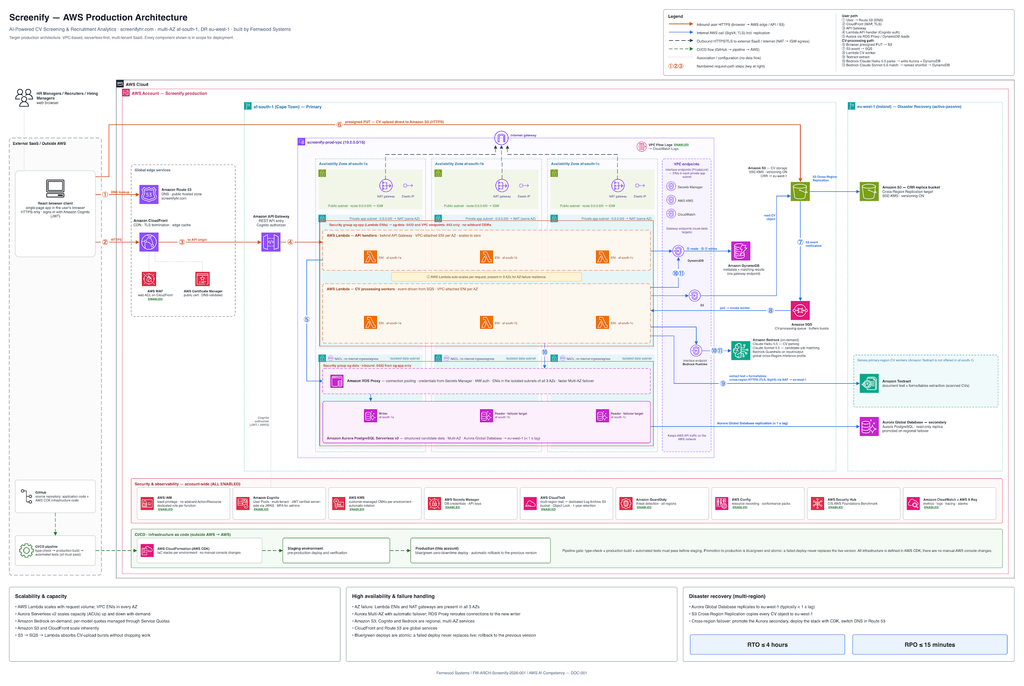
Figure 1: A serverless, event-driven pipeline extracts, parses and matches CVs without any always-on servers.
The CV pipeline
- The browser requests a presigned URL and uploads the CV directly to Amazon S3, so large files never pass through the API.
- The upload triggers a background AWS Lambda worker.
- Amazon Textract extracts text, forms and tables, including from scanned CVs.
- Claude Haiku 5.5 on Amazon Bedrock parses the extracted text into structured fields. It is fast and economical, which suits the high-volume step.
- Claude Sonnet 5.5 on Amazon Bedrock matches the structured profile to the job requirements and writes the explanation. It is the stronger reasoner, used where quality matters most.
- Results are written to Amazon DynamoDB and surfaced in the dashboard.
Splitting parsing (Haiku) from matching (Sonnet) is a deliberate cost-and-quality decision: each model does the job it is best suited to.
The application layer
- Amazon API Gateway fronts the REST API with an Amazon Cognito authorizer, so every request is authenticated before any Lambda runs.
- AWS Lambda hosts the API handler, the CV processor and the notifier. Each function’s IAM role is scoped to the specific tables, buckets and model identifiers it needs, with no wildcard access to Bedrock.
- Amazon SES sends notification emails.
- Amazon S3 holds uploaded and processed CVs, with lifecycle expiry on processed files.
- Infrastructure as code defines the stack, so environments are reproducible and nothing depends on manual console changes.
Why these choices
| Decision | Chosen | Rejected | Why |
| Compute | Lambda | Always-on servers | CV volume is spiky. Scale-to-zero means no idle cost |
| Document extraction | Textract | Self-built OCR | Handles scanned layouts, forms and tables as a managed service |
| Models | Bedrock (Haiku 5.5 and Sonnet 5.5) | Self-hosted models, one large model for everything | Right-sized model per step and IAM-native access |
| Data | DynamoDB | Provisioned relational database | On-demand capacity that scales with usage, with no idle cost |
| Identity | Cognito | Custom auth | Multi-tenant JWTs and no password handling in our code |
How it scales
Lambda scales concurrency with load. S3, DynamoDB, API Gateway and Cognito are regional managed services built across Availability Zones, so there is no server to size or fail over. Bedrock throttling is handled with SDK exponential back-off, and each CV is processed as an isolated job so one failure never affects another.
Responsible AI, privacy and security
Hiring is a high-stakes use of AI, so the controls are central.
- Human in the loop. Screenify recommends and explains. Recruiters make every hiring decision.
- Explainable scoring. Each ranking comes with the reasoning behind it, so a recruiter can challenge it.
- Bias audit. We run synthetic candidate profiles that differ only in gender-, school- and origin-coded signals, and check that scores do not covary with those attributes.
- Least-privilege IAM. Model access is scoped to the specific approved models, and every function has its own narrowly scoped role.
- Encryption in transit with TLS and at rest by default on S3 and DynamoDB, with secrets kept out of source code.
- Data residency. Candidate data is processed in af-south-1, in line with NDPA requirements.
What it delivers
- Minutes, not hours. A batch of CVs becomes a ranked shortlist without a recruiter reading every document.
- Consistency. Every CV is judged against the same job requirements, with the reasoning visible.
- Fairer screening. A bias-audit process and a human-in-the-loop model reduce the unconscious-bias risk inherent in manual review.
- Affordable by design. A pay-per-use serverless footprint puts AI-assisted screening within reach of African SMBs instead of enterprise ATS budgets.
Lessons learned
Right-size the model to the step. Using one large model for everything would have been simpler, but parsing is high-volume and structured, and matching is lower-volume and judgment-heavy. Splitting them between Claude Haiku 5.5 and Claude Sonnet 5.5 keeps quality where it matters and cost where it counts.
Least privilege includes the model. It is easy to grant a function permission to invoke any Bedrock model. We scope each function to the specific approved models, so a misconfiguration can’t quietly route CV data to an unreviewed model.
Want to bring AI into HR or any document-heavy workflow on AWS? Fernwood Systems is an AWS Advanced Tier Partner based in Enugu, Nigeria, with an office in Lagos.
Screenify: screenifyhr.com