

How Fernwood Systems built an availability-monitoring SaaS that checks every endpoint every five minutes and explains incidents in words a non-engineer can act on.
The short version
When a website or API goes down, every minute costs revenue and trust. Uptime Guard, live at checkwebsiteuptime.com, serves SMBs across Nigeria and West Africa who can’t afford enterprise monitoring suites and can’t afford to learn about outages from angry customers either. We built it fully serverless on AWS in af-south-1 (Cape Town). It checks registered endpoints every five minutes, alerts within seconds of a failure, and uses Amazon Bedrock to turn raw status codes into a clear incident summary and a daily anomaly report. If the AI is ever unavailable, the alert still goes out.
The problem: finding out from your customers
Before Uptime Guard, outage discovery for these businesses was reactive:
- Outages surfaced through customer complaints or ad-hoc manual checks.
- There was no single view across endpoints and no structured history for SLA reporting.
- Alerting relied on manual messages that failed off-hours.
- Even when alerts fired, raw data like “HTTP 503, 4,812 ms” needed an engineer to interpret.
Mean time to awareness ran to hours. The business needed it under a minute.
What we built
Uptime Guard is a multi-tenant SaaS with four jobs:
- Check every registered endpoint every five minutes.
- Alert by email within seconds of a detected failure.
- Explain. On a failure, Bedrock produces a natural-language incident summary covering what failed, for how long and how it compares to recent response times. Once a day, it scans response-time trends for anomalies.
- Show. A dashboard gives status, response times and uptime history at a glance, plus the data for SLA reporting.
Architecture
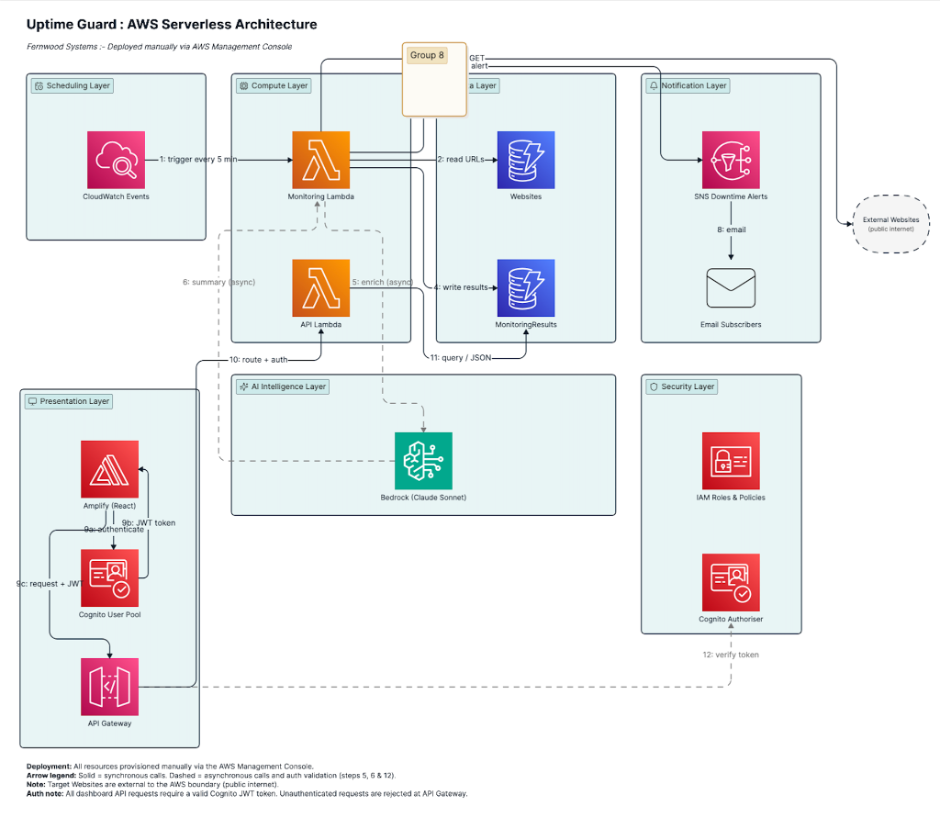
Figure 1: EventBridge triggers Lambda health checks. Failures flow to Amazon Bedrock for a summary, then to SNS for delivery. A plain-text fallback means the AI layer can never block an alert.
The monitoring path
EventBridge (every 5 min) -> Lambda (health checks) -> DynamoDB (results)
| on failure
v
Amazon Bedrock (summary) -> SNS -> email
A separate daily Lambda sends trend data to Bedrock for anomaly detection, with findings delivered through SNS.
The dashboard path
React on AWS Amplify -> API Gateway (Cognito JWT) -> API Lambdas -> DynamoDB
API Gateway validates the Amazon Cognito token on every request, so unauthenticated calls are rejected with a 401 before any Lambda runs.
Why these choices
| Decision | Chosen | Rejected | Why |
| Compute | AWS Lambda | EC2, ECS | A five-minute job doesn’t justify always-on servers. Lambda scales to zero |
| Scheduler | EventBridge | Self-managed cron | Nothing to patch or keep alive |
| Storage | DynamoDB | RDS | Pay-per-request, fast time-partitioned reads, no idle cost |
| AI | Amazon Bedrock | Self-hosted models | No infrastructure, and IAM-scoped access to one approved model |
| Alerts | SNS | Custom notifier | Second-level delivery without building a service |
| Hosting | AWS Amplify | Self-managed web servers | Managed CI/CD and hosting |
High availability and scale
Every core component (Lambda, DynamoDB, SNS, API Gateway) is a regional, multi-AZ managed service, so there is no single server to lose. Lambda concurrency scales with the number of monitored endpoints, and DynamoDB on-demand capacity scales with write volume.
The design rule that matters most: AI must never block the alert
An uptime monitor exists to deliver one message, fast. Calling a language model before sending that message adds latency and a new failure mode at the exact moment the customer is already having a bad day.
So the AI is strictly non-blocking. The raw alert goes out immediately. If Bedrock is slow, throttled or unavailable, a plain-text alert is sent anyway and the AI summary is best-effort. Monitoring and alerting do not depend on model availability.
Responsible AI and security
- No PII in prompts. Bedrock only ever sees URLs, status codes and response-time metrics.
- AI summarises and never decides. It takes no autonomous action.
- Least-privilege IAM. Each Lambda can touch only its own tables and topics.
- Secrets live in AWS Systems Manager Parameter Store, TLS 1.2+ is used throughout, and Cognito handles identity.
- Cost guardrails. Bedrock is invoked only on genuine failures and on the scheduled daily analysis, never on every check, with usage limits and CloudWatch cost monitoring.
What it delivers for the business
- Proactive awareness. Outages are detected by the system within a five-minute check cycle and alerted within seconds, instead of being reported by customers hours later.
- Alerts people can act on. Non-technical stakeholders get a plain-English explanation instead of raw status codes.
- SLA-ready history. Every check is stored, so uptime trends and availability reporting are a query away.
- Near-zero operating overhead. No servers to patch, no idle compute, and pay-per-use costs that suit an SMB market.
Lessons learned
Keep AI out of the critical path. Model latency and occasional throttling meant a synchronous Bedrock call could delay the very alert it was enriching. Decoupling alerting from summarisation, with a plain-text fallback, is now our standard for AI-augmented alerting.
Put an AI-cost envelope in the scope. A spike in outages means a spike in model calls. We cap and monitor usage, and we now agree expected model spend with the customer before building.
Need production AI on AWS without the infrastructure overhead? Fernwood Systems is an AWS Advanced Tier Partner based in Enugu, Nigeria, with an office in Lagos.
Uptime Guard: checkwebsiteuptime.com